I was reading through my morning emails last week when I saw this one about an executive order President Trump signed on April 30, 2026. It directs the Treasury Department to launch a site called TrumpIRA.gov — and if you don’t have a workplace retirement plan, it might actually matter for your wallet.
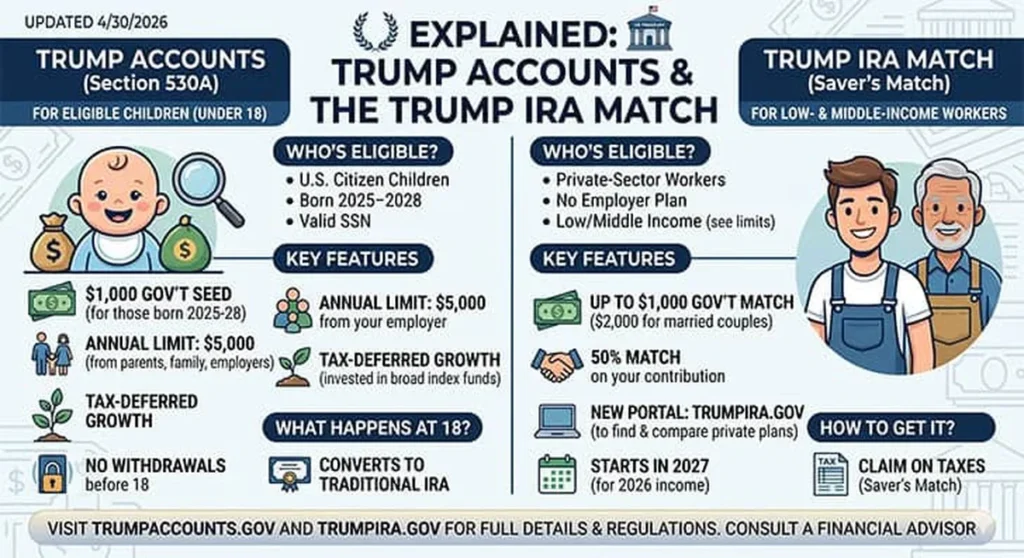
Here’s my quick take: this isn’t a brand-new type of account. It’s an easier doorway into IRAs that already exist, plus a government match for lower-income savers that could add up to $1,000 a year starting in 2027.
{{image:cover.webp}}
Who Qualifies?
The platform targets workers whose employers don’t offer a 401(k) or similar plan. That’s roughly 40% of full-time employees and about 80% of part-timers.
If you earn under about $35,500 (single) or your household earns under $71,000 (joint filers), you may qualify for the Saver’s Match. It kicks in during 2027 and covers up to 50% of your contributions, capped at that $1,000 annual match. The money goes straight into your retirement account.
Any worker can use TrumpIRA.gov to compare and enroll in private-sector IRAs — even if you don’t qualify for the match.
How It Differs from What You Already Know
TrumpIRA.gov doesn’t invent a new account structure. It streamlines enrollment into traditional or Roth IRAs, particularly for gig workers, part-timers, and small-business employees who usually fall through the cracks.
A few comparisons that helped me sort it out:
- Vs. employer 401(k): No employer match required. Easier to set up on your own. Contribution limits follow standard IRA rules — $7,000 for those under 50 in recent years, plus catch-up contributions if you’re older.
- Vs. a regular IRA: The difference is the facilitated enrollment through the platform and the Saver’s Match boost for qualifying earners.
- Child “Trump Accounts” (separate program): These are custodial IRAs for kids under 18, with a $1,000 federal seed for births from 2025 to 2028 and up to $5,000 in annual contributions. The April 30 announcement focuses on adult workers.
Tax treatment mirrors standard IRAs: Traditional gives you upfront deductions (if eligible) and tax-deferred growth; Roth means tax-free qualified withdrawals. Early withdrawals before age 59½ generally face penalties, which is meant to encourage long-term holding.
What I’d Look For in a Plan
The site will work like a marketplace — you filter plans by fees, minimums, and investment options. Based on what I’ve learned from reading investor wisdom over the years (Bogle’s low-cost indexing approach is still solid advice), here’s what matters most:
- Prioritize expense ratios under 0.1% where possible.
- Stick with broad-market index funds or ETFs rather than chasing hot picks.
- Avoid high-fee products that eat into compounding over decades.
The full Saver’s Match integration is targeted for 2027. Treasury handles the platform and match; private donors may contribute in the future.
{{image:image-01.jpg}}
Worth It?
Verdict: Worth it, especially if you earn under $35,500 or your employer doesn’t offer a retirement plan.
The government match alone — up to 50% of what you put in, max $1,000 — is essentially free money. Even without the match, having one place to compare low-cost IRA plans saves time and helps avoid expensive products.
FAQ
When does TrumpIRA.gov launch?
The website is under development now. Full Saver’s Match integration is targeted for 2027.
Do I need earned income to contribute?
Yes — the standard IRA earned-income requirement still applies. TrumpIRA.gov doesn’t change that rule, but it does lower barriers for gig workers and part-timers.
Can I open a Roth or Traditional?
Both options are available through private-sector plans on the platform. Tax treatment mirrors standard IRAs — Traditional for upfront deductions, Roth for tax-free qualified withdrawals.
A Note from Dana
I’ve always believed that consistent saving beats trying to time the market perfectly. Tools like TrumpIRA.gov make participation simpler for more people — and a $1,000 government match is hard to argue with. Keep an eye on TrumpIRA.gov for launch details, and if you’re eligible, plan your contributions early so you don’t miss that match.