I was looking at housing numbers this morning when I realized something: if you’re shopping for a home right now, there’s a new mortgage term floating around that could change the math entirely. President Trump’s proposed 50-year mortgage.
It sounds appealing on paper — lower monthly payments, easier qualification. But like any deal worth examining, the fine print matters. Let me break it down for you.
The History of Mortgages in the US
Mortgages have come a long way from the short-term loans with big balloon payments that dominated the 1800s and early 1900s. Back then, borrowers typically put down 50% or more.
The Great Depression changed everything. The FHA was created in 1934 to insure loans, and by the 1940s the 30-year fixed-rate mortgage became the gold standard — fueled by post-war prosperity and programs like the GI Bill.
Since then we’ve seen ARMs emerge in the 70s and 80s, shorter 15- and 20-year options gain ground in the 90s, and tighter oversight after 2008. Homeownership hovers around 65-66% today.
Traditional Mortgage Lengths Available Today
The most common terms are 15, 20, and 30 years. The 30-year accounts for about 90% of new loans — lowest monthly payments, but you pay interest longer. The 15-year means higher payments and rates typically 0.5% to 1% lower than a 30-year. The 20-year sits in the middle.
I’ve been five years into my own 20-year mortgage — we landed somewhere between cautious and optimistic.
Trump’s Proposed 50-Year Mortgage Plan
The idea is straightforward: extend the standard loan term from 30 to 50 years, potentially through changes at Fannie Mae and Freddie Mac. The proposal surfaced during the 2024 campaign and has been discussed since Trump took office.
Stretching payments over five decades could cut monthly costs by 10-15%. On a $300,000 loan at 6%, a 30-year term means about $1,799 per month. A 50-year would bring that down to around $1,579 — a savings of over $200 monthly.
The administration is also exploring portable mortgages, so borrowers could transfer low-rate loans to new homes.
Will It Actually Happen?
As of November 2025, the proposal is under active evaluation by the Federal Housing Finance Agency (FHFA). Industry experts have concerns: borrowers could pay hundreds of thousands more in interest over the life of the loan, and lenders might demand higher rates for longer terms.
Congress would need to approve changes to Fannie and Freddie. Recent reports suggest the idea is losing steam. If it does move forward, it may start as a pilot program for certain buyers.
What You Need to Know: Pros and Cons
Pros:
- Lower monthly payments — more room in your budget for emergencies or investments.
- Easier qualification — helpful if your income is moderate.
- Potential appreciation — over 50 years, home values could rise significantly.
Cons:
- Massive interest costs — you might pay double the home’s value in interest alone.
- Slower equity build — it takes longer to own your home outright.
- Life changes — carrying debt into retirement age adds risk, especially with job loss or health issues.
Comparing Mortgage Terms: The Numbers
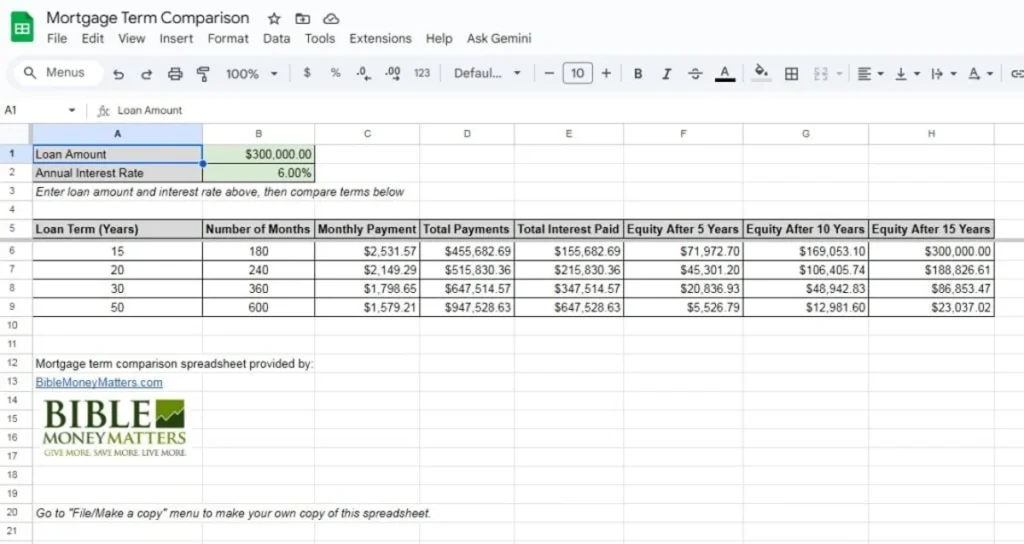
Here’s how the payments stack up on a $300,000 loan at 6%:
- 15-year: $2,532/mo — $156,000 total interest — $456,000 total paid
- 20-year: $2,149/mo — $216,000 total interest — $516,000 total paid
- 30-year: $1,799/mo — $348,000 total interest — $648,000 total paid
- 50-year (hypothetical): $1,579/mo — $648,000 total interest — $948,000 total paid
The pattern is clear: longer terms slash monthly costs but balloon total interest. In reality, shorter loans often carry lower rates too, which amplifies the savings even further.
{{image:cover.webp}}
Want to run your own numbers? Download a free mortgage comparison spreadsheet (Google Sheets or Excel) where you can plug in any loan amount and rate.
A Note on Debt
Proverbs 22:7 says, ”The rich rule over the poor, and the borrower is slave to the lender.” It’s a good reminder to approach debt wisely — don’t let it become your master.
Frequently Asked Questions
What is a 50-year mortgage?
A home loan repaid over 50 years instead of the standard 30. It lowers your monthly payment but increases total interest paid significantly.
How does it compare to a 30-year mortgage?
On a $300,000 loan at 6%, a 30-year costs about $1,799/month with $348,000 in interest. A 50-year would be $1,579/month but $648,000 in interest — lower payment, much higher overall cost.
Is Trump’s plan likely to become reality?
It’s under evaluation by the FHFA but facing skepticism. Congressional approval is needed. As of 2025, it may launch as a pilot rather than a full rollout.
A Note from Dana
My family and I locked in a 20-year mortgage at 2.375% — we lucked out on timing and are already a quarter of the way through. A 50-year term would be a non-starter for us, honestly. Americans stay in their homes an average of 8 to 13 years before selling or refinancing, and first-time buyers often move after just 5 to 10 years. If you’re not planning to stick around long-term, a 50-year mortgage means you’ll sell before building meaningful equity. Definitely something to weigh carefully.
What do you think — would a lower monthly payment be worth the extra interest? I’d love to hear your thoughts in the comments.