
I’ve spent a long time squinting at my own bank statements, trying to figure out what people who are actually ahead on money do differently. So when I got my hands on a long, detailed interview with a 44-year-old supply-chain manager whose family net worth sits around $1.82M, I didn’t skim. I read the whole thing — twice.
He’s a mid-level manager in supply chain at a pharmaceutical company, living in a suburban-rural coastal town in the northeast. His base salary is around $169,000, with bonuses that can push total pay to roughly $175,000 to $220,000. His wife, an elementary school teacher, earns around $80,000. They have a 14-year-old daughter and a 10-year-old son, and will have been married 16 years this July.
No trust funds, no side hustles, no real-estate empire. Just a salary, a plan, and a lot of small habits. That’s exactly the kind of blueprint I want to pass along. The interview was conducted in March 2026 and runs long, so I’m splitting it into two posts. This one covers where the money comes from and where it goes.
At a glance
- Net worth: around $1.82M as of March 2026 (total assets $2.126M, total debts $304K)
- Household income: roughly $249K–$300K combined (his base ~$169K with variable bonuses, her ~$80K)
- Automated saving: 12% of his paycheck to a Roth 401k, plus a 4.5% employer match, plus $400 a month into each child’s 529 ($800 total)
- Four-year average spending: $157,100 a year including taxes, $94,600 without them
His full asset breakdown, as he shared it:
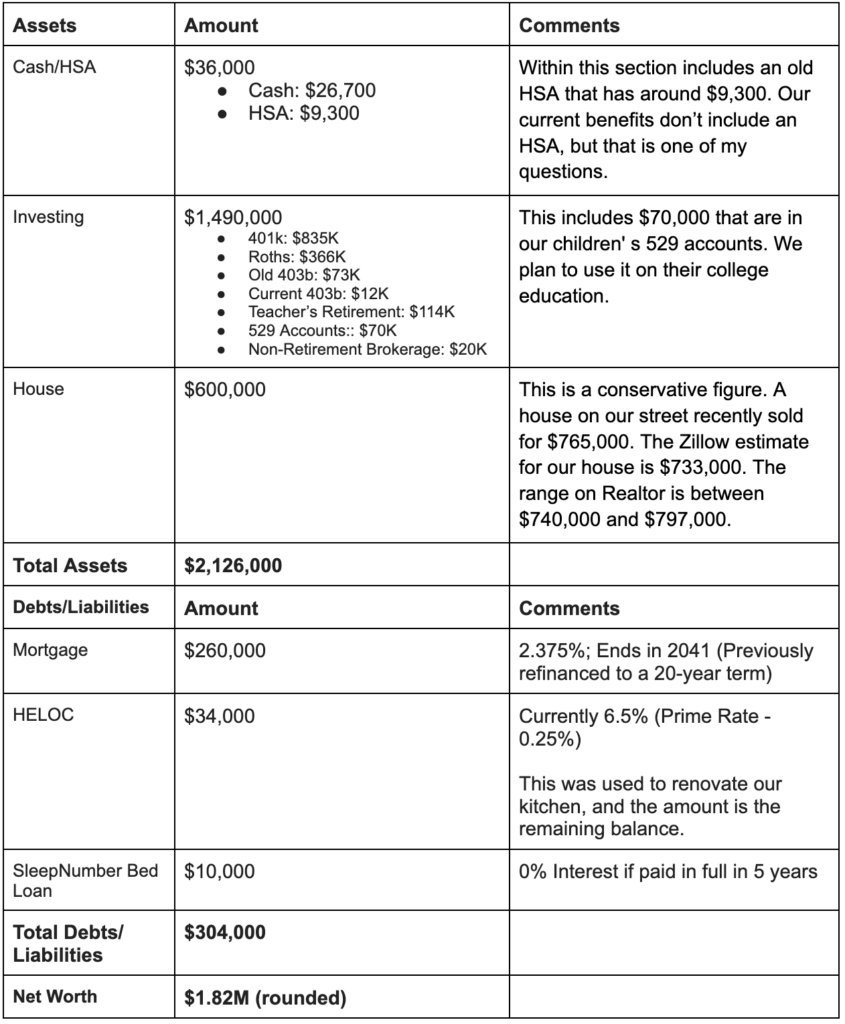
We pay our credit cards off in full each month, so they don’t show up in those figures. The only debt worth flagging: a mortgage, a HELOC, and a $10K SleepNumber bed loan at 0% interest over five years. Everything else is cleared monthly.
From $30K to $169K: the income story
He started out making $30K to $35K right after college, as a Training Specialist at a small software startup — employee number 11 of 25. The job took him to over forty states (he still hasn’t been to Maine, which he finds ironic given where he lives), and in the early days the owners were withholding their own pay to make sure the rest of the team got paid.
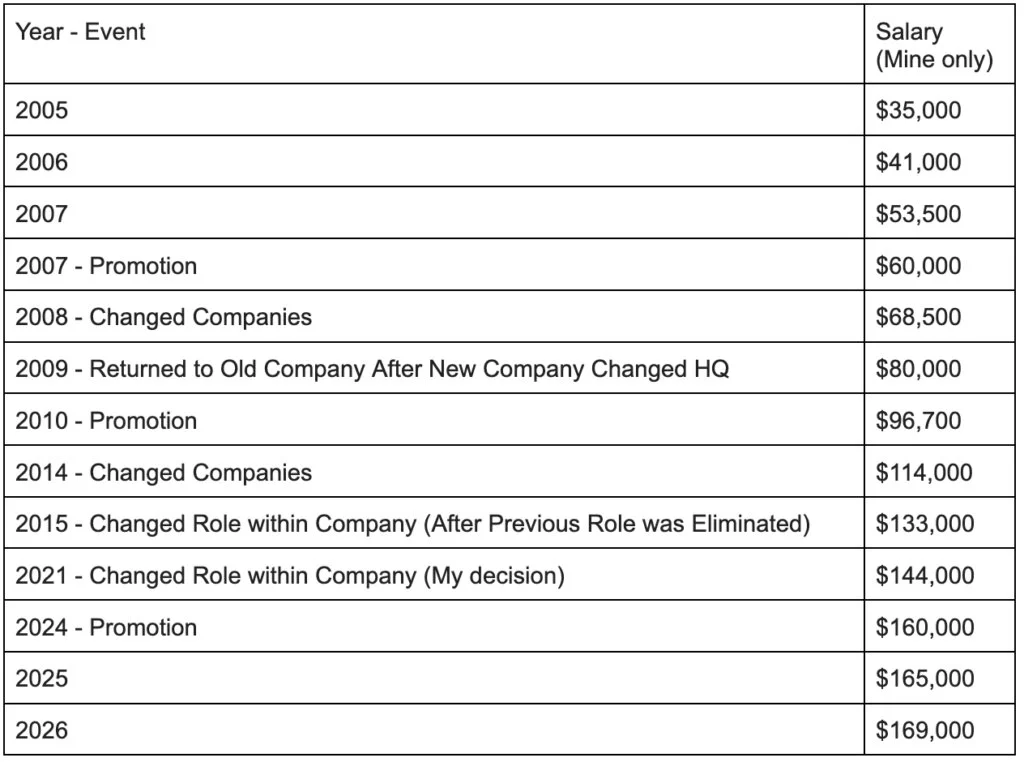
Here’s the salary history in full, from his own records:
The short version: he changed companies several times. Around three years in at the startup, it was acquired by a mid-sized company (about 100 employees), and he got a small staying bonus. Around 2008 he was promoted to an Implementations Manager role that, on paper, sounded great — in practice he felt like he was “always just a little behind.” He left for a bigger company with better benefits. Within his first week there, his company announced it was acquiring another firm and closing his office, with a planned move to Pittsburgh. Family was closer at home, so when his old employer called twice, he went back — and negotiated a small sign-on bonus in the process.
He married and had his first child during that period. Around 2013 the owners sold the company, his boss was let go, and he tested the market again. A pharmaceutical company offered him a project-management role with a number the old employer couldn’t match, so he made the jump.
Then came the re-org. In his first year at the big company, his role was eliminated and his entire department disbanded. He interviewed internally and landed in financial portfolio management a week before his “impact date.” That scare changed how he worked: the company paid for his MBA (a three-year program; he only paid for books), and he also got his PMP certification. A study group from the MBA program included two supply-chain folks, and after one informal conversation with a classmate, he moved into the supply chain organization, where he’s been since 2021.
His advice on growing career income? Both switching companies and growing internally can work — if the timing is right. But make yourself harder to lose. He did that with the PMP and the MBA. And don’t burn bridges: he went back to a former employer once, and he advanced into a new area of his current company because of relationships he’d built over the years.
What he actually spends
This is the part I want most readers to linger on. He ran a Quicken report on the last four years — January 2022 through December 2025 — and shared it in full. Including taxes, the household averages $157,100 a year in spending. Back out taxes, and it’s $94,600.
One honest caveat before the tables: he and his wife run a “yours, mine, ours” money system, and his paycheck has extra federal withholding taken out to balance things at tax time — which is why the taxes line looks high. His wife also covers their daughter’s dance classes from her own bucket, so that’s excluded.
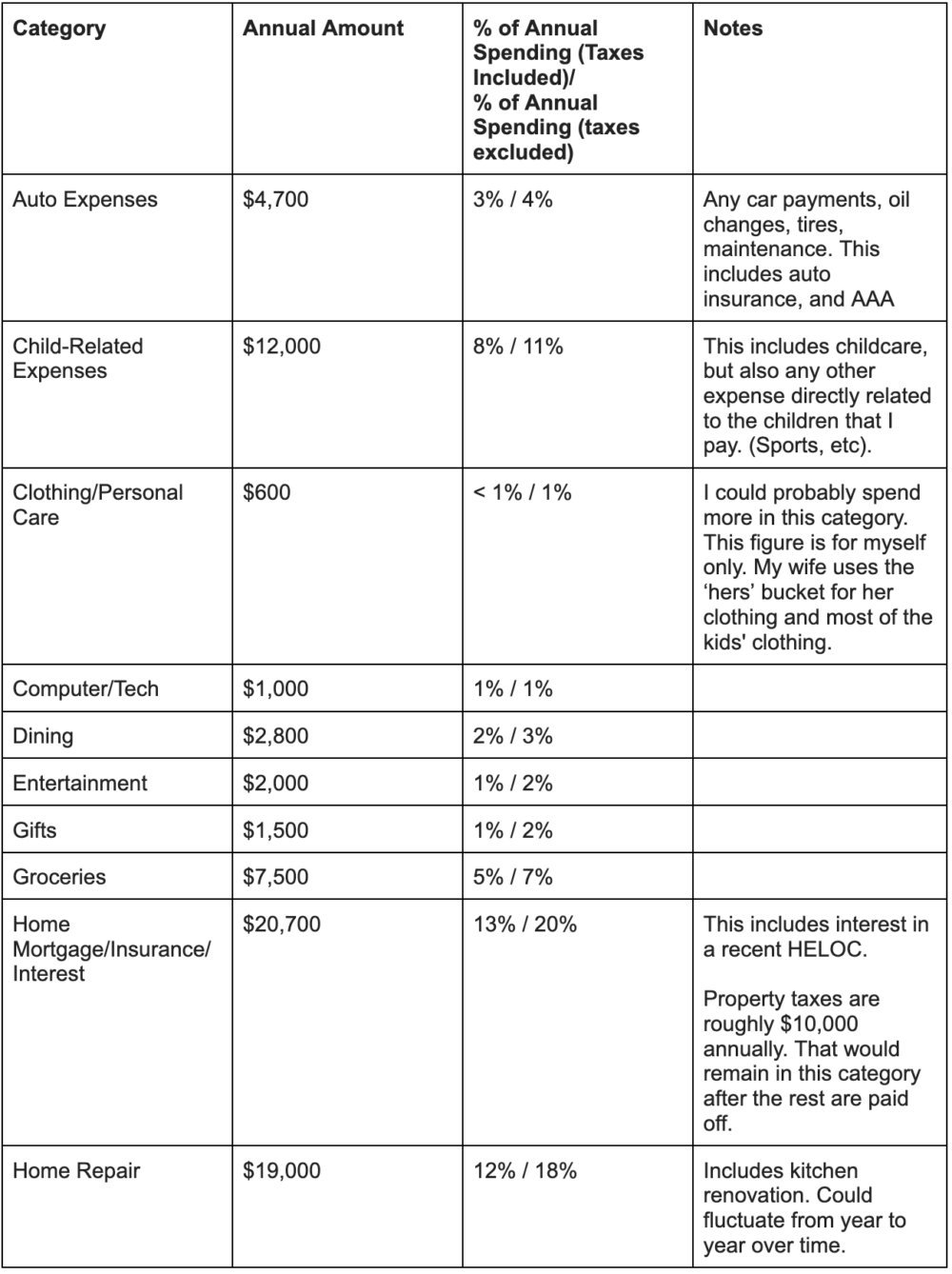
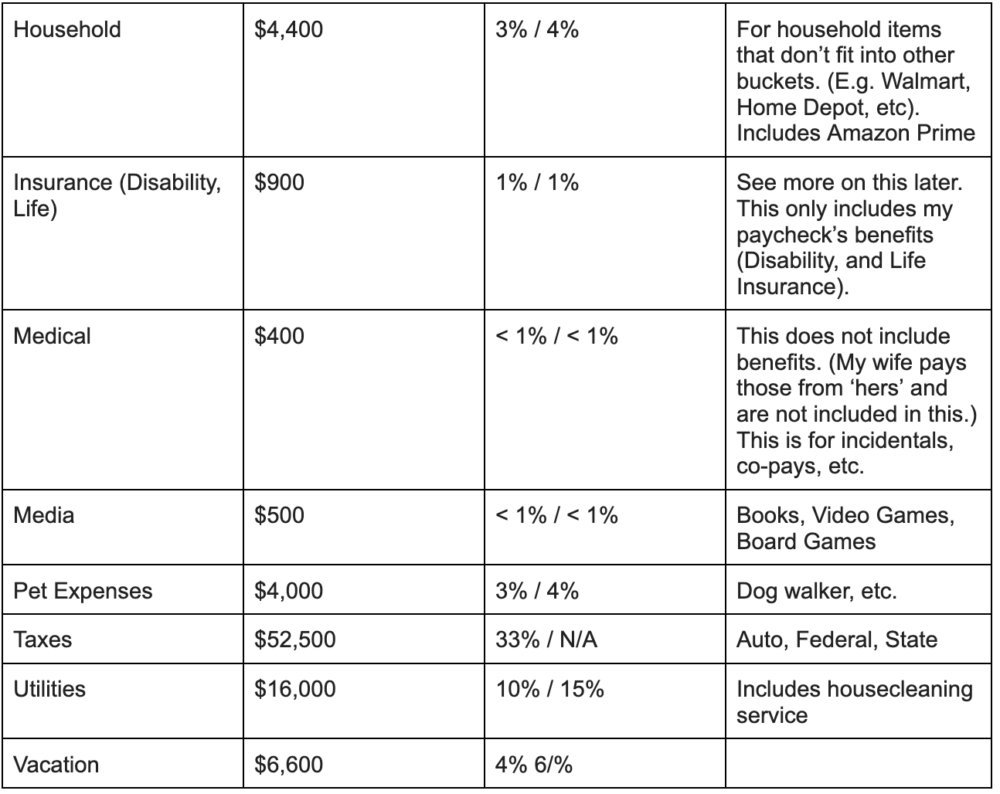
A few lines I’d circle: the mortgage, insurance, and interest come to about $20,700 a year on a home that carries a $260K mortgage at 2.375%, maturing in 2041. Home repair runs about $19,000 a year — more than most of my reader comments admit. Groceries are $7,500, dining out $2,800, vacations $6,600, and the HELOC — $34K outstanding at 6.5% — is something he’s actively paying down right now.
Do they budget? “We don’t really follow a budget,” he told me. He built one in Quicken a few years ago and adjusts it every few years, but never remembers to check against it. He does track every transaction, and every so often runs a spending-by-category report to see if anything stands out.
The saving system that actually runs itself
Here’s where it gets good. As a corporate employee, he has limited control over what he earns — but full control over where the money goes. So he automated the rest:
- 12% of every paycheck (bonuses included) goes straight into his Roth 401k. His employer matches 4.5%. That’s free money on top of his contribution, and it never hits a checking account where it could get spent.
- $400 a month goes to each child’s 529 plan — $800 total. His wife contributes 4% to a 403(b) with no match.
- Once a month, money moves into an online savings account that pays better interest than his local bank, used for short-term saving and the emergency fund.
He used to fully fund Roth IRAs for both of them, but stopped when they crossed the income limits. He tried back-door Roth contributions and wasn’t consistent. Right now, his focus is paying down the HELOC rather than saving above what’s already automated.
His one-line philosophy: “If you never see it, you can’t spend it.” The automation does the saving; he just doesn’t touch it.
Quick disclaimer: this is one family’s setup, not professional financial advice. Your numbers, taxes, and employer plans will be different.
How he spends less without feeling like he’s spending less
A few habits here read exactly like my own grocery-store brain, which made me smile:
- Price history before purchase. Once he’s decided what he wants, he checks the product’s price history — “what was the best price this item went for” — and waits patiently for it to drop. Willingness to wait is the whole trick.
- Unit price, the honest way. He does 95% of the grocery shopping and keeps a unit-price app on his phone. Some people will tell you the unit price is on the shelf tag. It’s not always consistent, and the units can differ product to product. He also factors the sale price into the calculation, and when an item hits his personal threshold, he stockpiles.
- Generic if it’s identical. If a generic grocery item tastes the same as the name brand, that’s what goes in the cart. Price always matters — but so does value. A $20 belt that falls apart in a year isn’t a bargain. A $40 belt that lasts a lifetime probably is. You get what you pay for on both ends of the spectrum.
- Cash back, used like a tool. He uses an Amex Blue for 6% cash back at grocery stores, a Citi Double card for 2% everywhere else, a Chase Freedom card for rotating 5% categories, and his Costco card for dining, gas, and Costco. He’s careful to pay everything off — the cards earn, they don’t finance.
And the splurge list? Restaurants, cooking (for a house of picky eaters), video games — usually years behind the current releases, on purpose — and books. He hunts for good used books at a large store nearby and grabs e-books when they drop to the $2-or-less range.
Worth It?
Worth it — for anyone who thinks net worth is a mystery. The honest takeaway: $1.82M isn’t magic. It’s a $169K salary, a $80K teacher’s salary, 12% automated into a 401k with a 4.5% match, $800 a month into two 529s, and a family that knows exactly what it spends because it tracks every transaction. The part that’s hard to copy is the patience — waiting out price histories, buying used, staying in one region for 40 years to stay near family.
a note from Dana — I’ve done the price-history trick on a few purchases and it genuinely feels like cheating. I’ll be waiting on Part 2, where he covers the investment side in more detail. In the meantime, if you only do one thing from this post: check what your employer match is, and make sure you’re actually taking the full amount. It’s the closest thing to a guaranteed return you’ll ever get.