The scariest part of a cancer diagnosis isn’t the treatment. It’s the paperwork that shows up the same week — and one of those forms might be the retirement income decision, the one you get three months before your 65th birthday. A new study just put a real number on what it costs when you let the pre-filled option win that decision: $21,558.
That figure comes from Boston College’s Center for Retirement Research, summarizing a 2026 Management Science paper by Hagen, Hodor, and Hurwitz. They looked at 241,896 retirees from a major Swedish pension plan and asked a simple question: when you learn you might not live as long as expected, do you change what you’re signing up to receive?
The honest answer: barely. And that’s the part that should make anyone with a 401(k) sit up, because U.S. financial firms are actively pushing to make annuities the default payout option there.
First, what an annuity actually does
If retirement math isn’t your thing, here’s the plain-English version. An annuity is a guaranteed paycheck from your pension pot. You stop worrying about the market or about outliving your savings; the provider pools everyone’s money and pays people who live longer out of the money left behind by people who die earlier. It’s the “this price is worth looking at” move for anyone who’s genuinely afraid of dying broke at 92.
The catch: an annuity’s value depends on how long you expect to live. Expect a long, healthy life and it’s a bargain. Expect a short one and it’s the worst deal in the shop. The researchers tested exactly that, using the one clean way to measure it: a first-time cancer diagnosis, which everyone agrees is a shock to your life expectancy.
The study: same people, diagnosis timing is the only difference
Sweden’s occupational pension works like this: the default payout is a life annuity starting at 65, and you can instead opt out into fixed-term payments over 5, 10, 15, or 20 years. Three months before your 65th birthday you get a seven-page letter that shows the annuity’s monthly amount — the fixed-term amount only appears buried on one page.
Once you choose, you’re locked in. No takebacks.
The researchers compared retirees who were diagnosed with cancer in the three years before retirement (14,945 people) with ones diagnosed in the three years after (15,117). Timing like that is effectively random, which makes this close to a natural experiment: same people, same plan, same letter — the only difference is whether they knew their diagnosis at decision time.
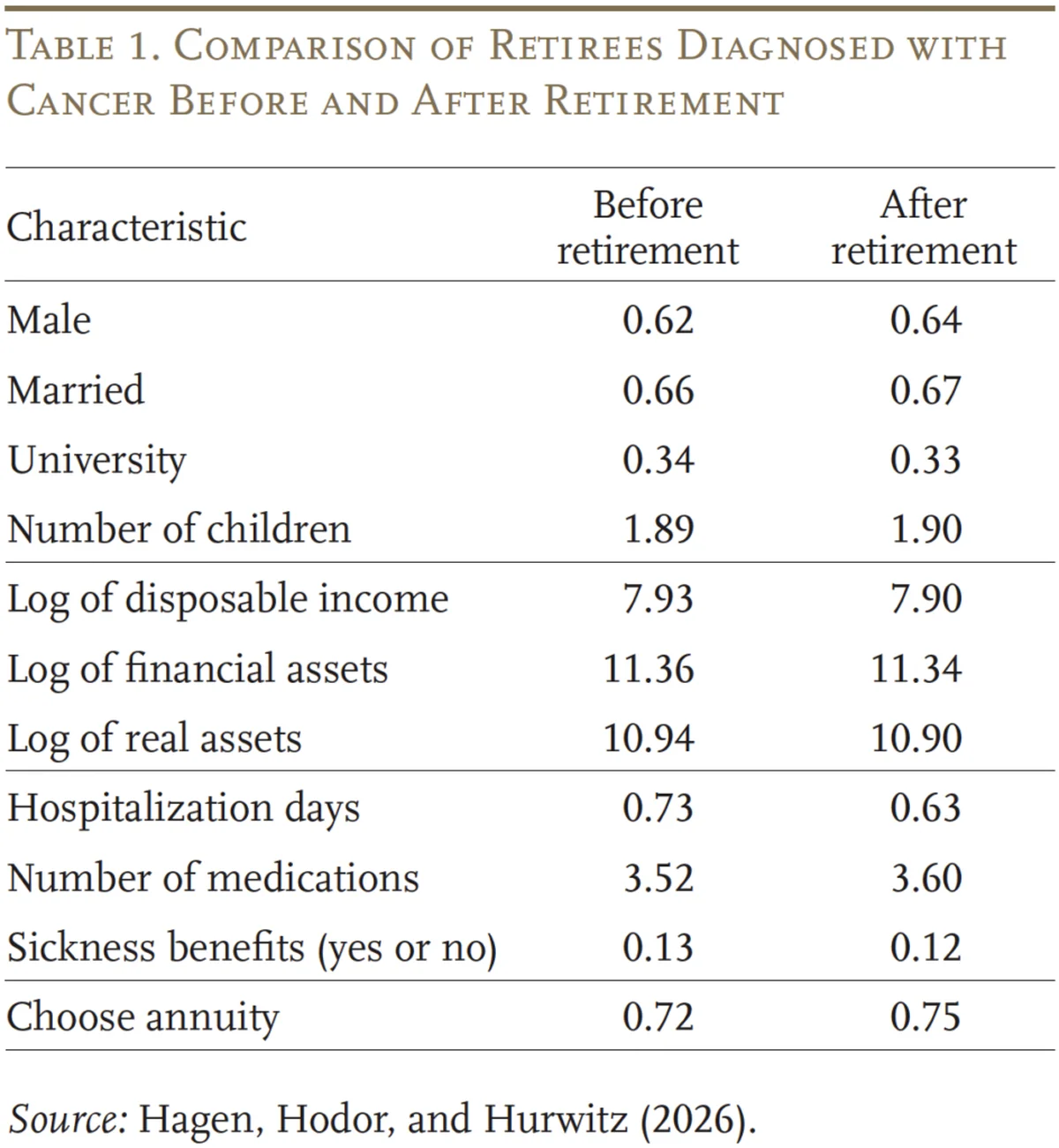
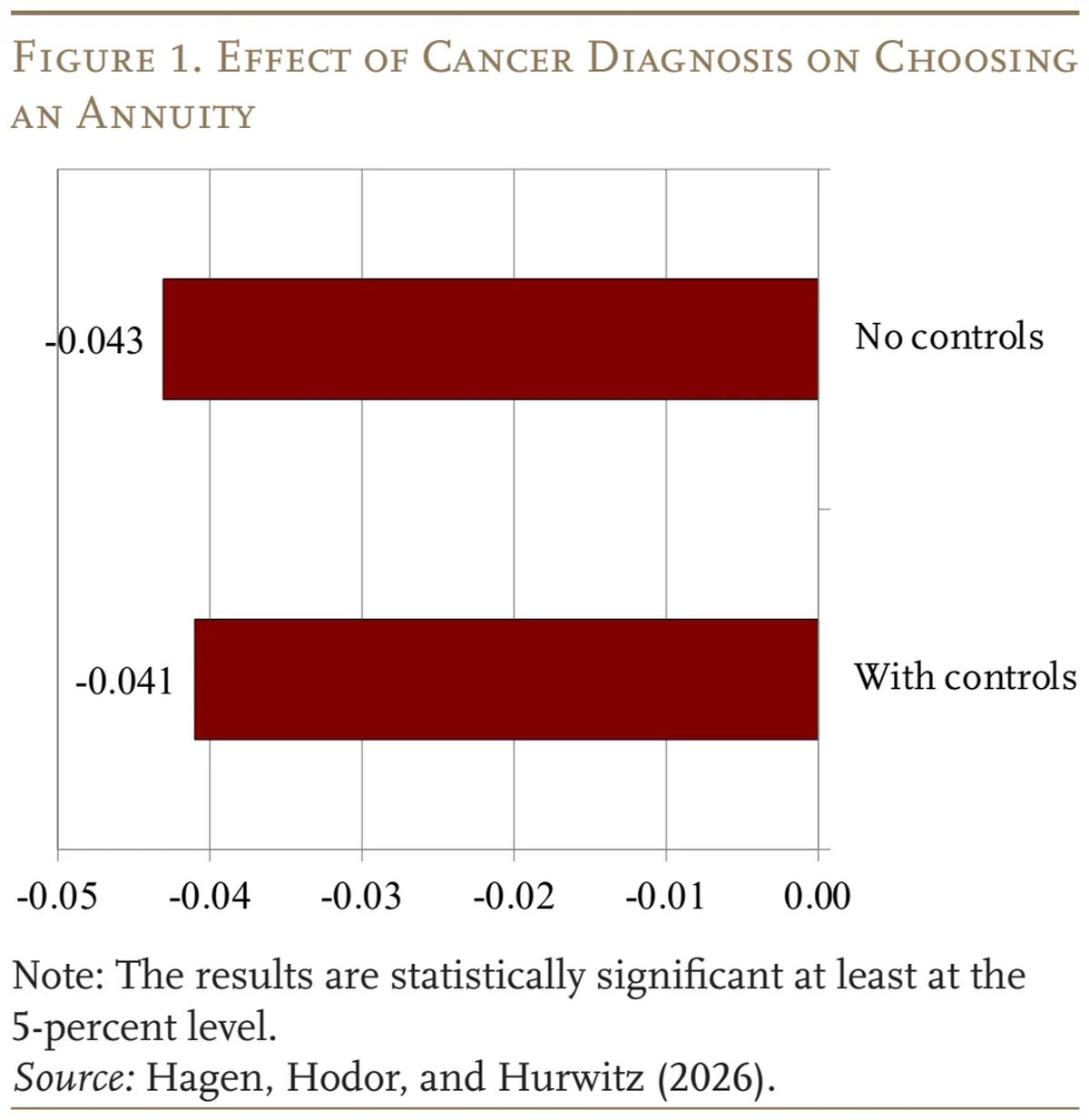
The two groups were nearly identical in age mix, income, assets, health, and everything else you can measure. The only real difference was the payout choice. People diagnosed after retirement annuitized at 75 percent. People diagnosed before retired annuitized at 72 percent.
A 4 percentage point gap. That’s the entire response to a diagnosis that measurably shortens life expectancy.
And that 4 points is worth $21,558
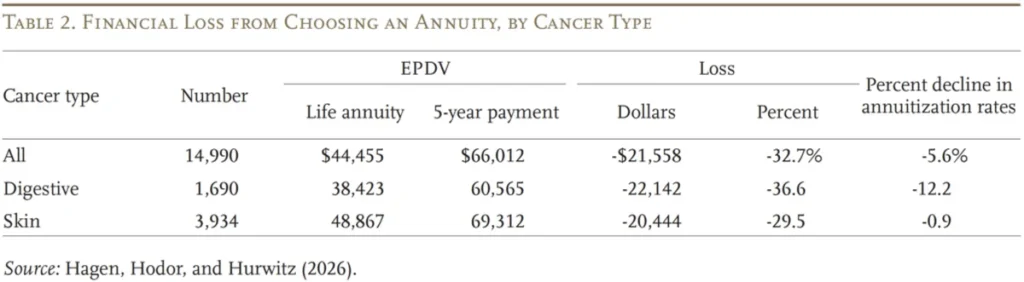
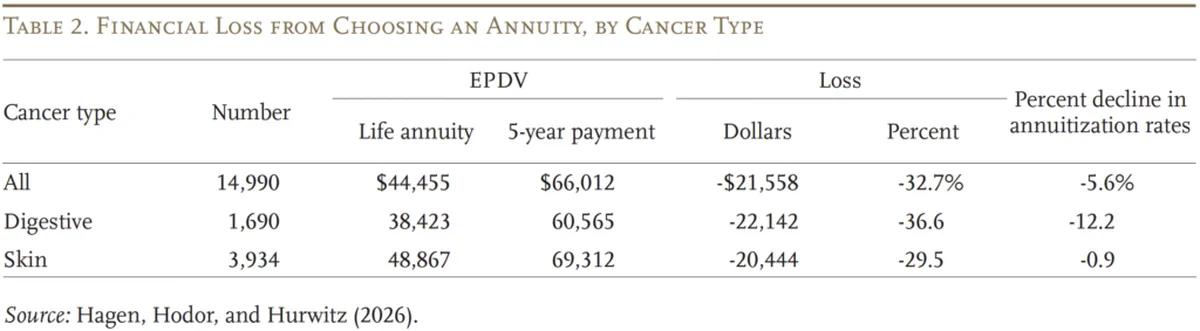
Here’s where it stops being academic. For a person with a cancer diagnosis, the expected value of the annuity — what the stream of payments is actually worth today — was $44,455. The five-year payout option was worth $66,012.
Choose the annuity and you walk away with $21,558 less, or 32.7 percent of the five-year option’s value, on average.
And it’s not uniform. Digestive cancers, which carry lower survival odds, showed the sharpest response — an 8.7 percentage point drop in annuity demand, and a 36.6 percent loss for those who still chose the annuity. Skin cancer, far less lethal, produced no significant change in demand at all, though the dollar loss was still 29.5 percent.
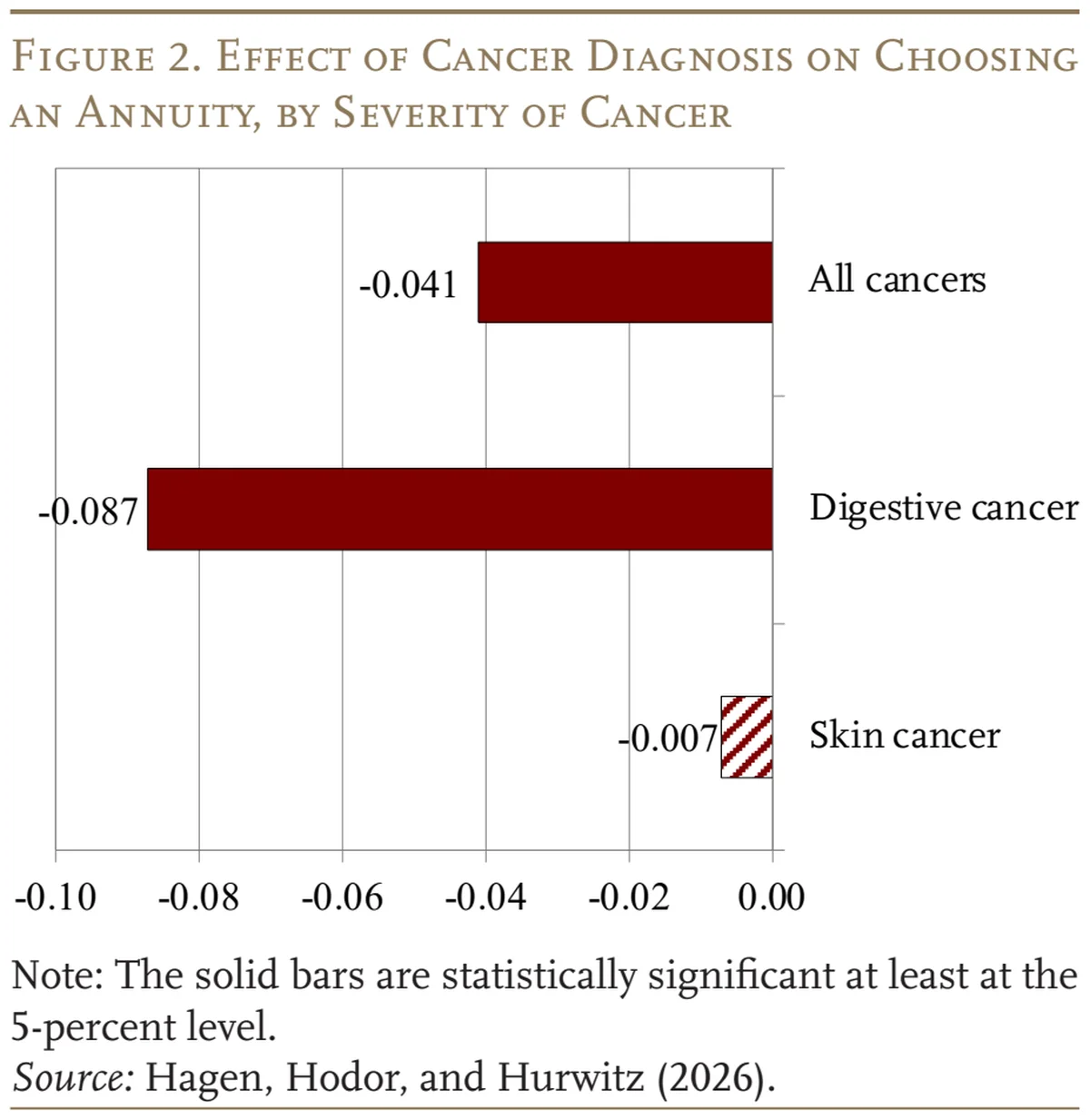
Think about that last part. People with skin cancer — a diagnosis most of us would shrug off — were just as likely to lock in the annuity, and just as exposed to a roughly 29.5 percent loss as a result. The plan didn’t know what the diagnosis meant, and neither did the person signing.
Why so few people change their mind? The default is to blame
Four percentage points is a small number, but the researchers weren’t satisfied with “people are stubborn.” They ran a lab experiment with students at the Hebrew University of Jerusalem and Tel Aviv University. Participants split money between an annuity and a lump sum under two longevity scenarios — high and low — with and without a pre-filled default choice.
The result is the clearest finding in the whole paper.
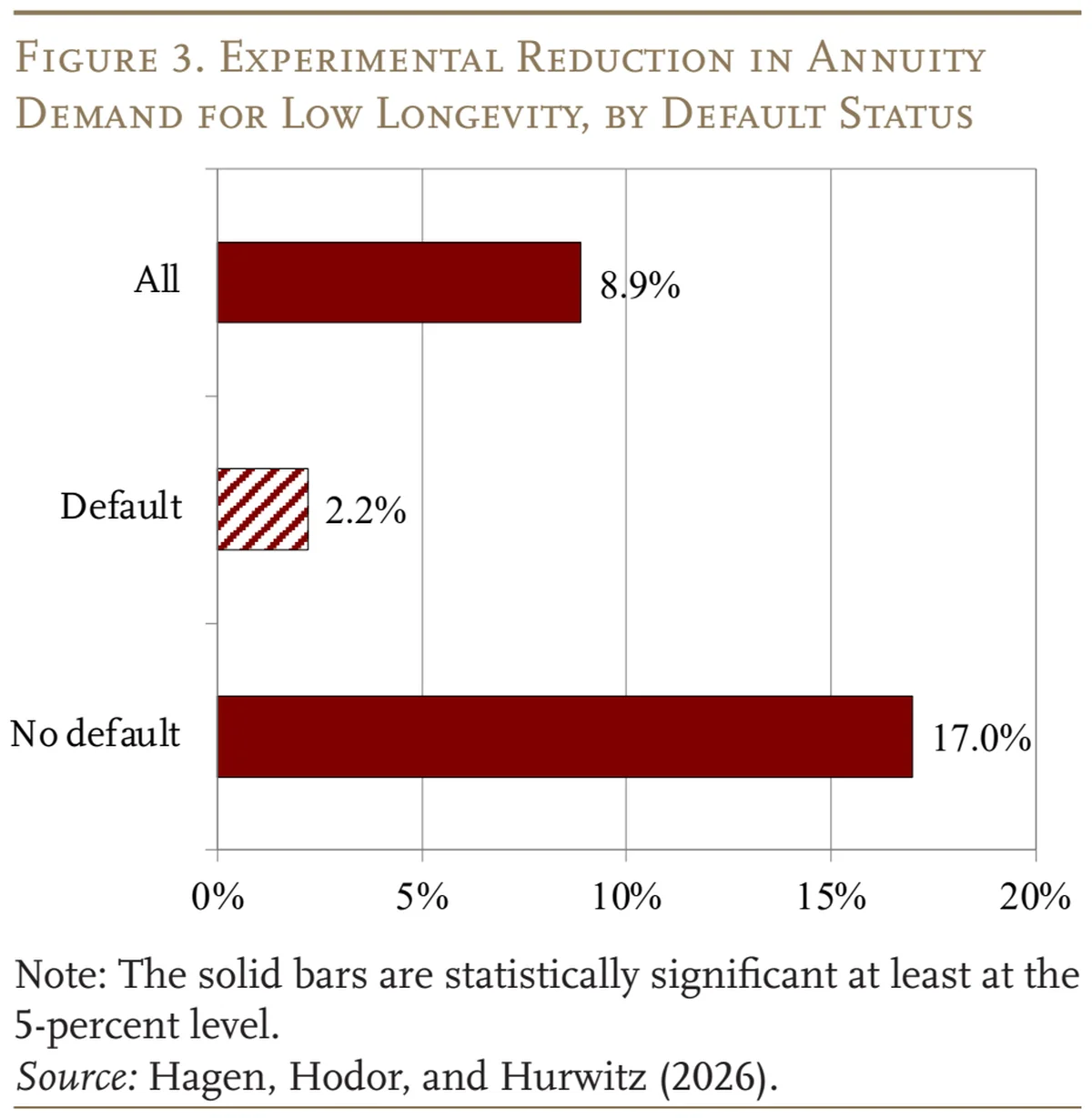
Participants in the low-longevity group cut their annuity demand by 8.9 percentage points on average. But that average hides a split: when an annuity was the default, they only cut it by 2.2 points. When there was no default, they cut it by 17 points.
The default didn’t just nudge people toward the annuity. It made people ignore their own private health information. That’s the mechanism, and it explains why 72 percent of the diagnosed-before group still signed up.
Does this apply to your 401(k)?
Not automatically, but close enough to watch. The Swedish plan is a real, functioning pension with a default annuity — the same structure U.S. firms are testing now. Two differences matter:
- The Swedish payout choice is irreversible. Ours often have more wiggle room, which means people are probably even less responsive than this “worst case” estimate suggests.
- The letter was neutral, and the alternative payout was buried on one page. If your 401(k) provider is good about showing you the actual numbers side by side, the default’s grip loosens.
The practical takeaway: when you get that pre-filled form, don’t sign what’s already there. Look up the fixed-term numbers for your actual situation, and if a health diagnosis has changed your outlook, price both options against each other before you commit.
Worth It?
Default annuitization: it depends. For a healthy 65-year-old with no family history, the default is probably fine — that’s what it’s for. The moment a health shock enters the picture, “default” stops being a decision and starts being a $21,558 tax on inattention.
Is a default annuity in a 401(k) a good or bad thing?
Both, honestly. Defaults are why most Americans actually have retirement savings at all — that part is proven. The risk, per this study, is that the same default keeps people locked into an income stream that no longer matches their real life. The fix isn’t no default; it’s a default that gets re-checked when circumstances change.
What’s an EPDV, and why should I care?
“Expected present discounted value” — the today-dollar value of a stream of future payments. It’s how you compare two payout options that look different on paper but pay out over different periods. The $44,455 vs. $66,012 comparison above is exactly this, and it’s the number your financial advisor should be running for you.
How big is the sample, and can I trust it?
241,896 retirees, with the cancer comparison group at 30,062. The pre- and post-retirement diagnosis groups were statistically indistinguishable on every measured characteristic, which is what you want from a natural experiment. The lab experiment adds a second, independent confirmation that the default is doing the heavy lifting.
a note from Dana: I once skipped reading a full auto-enrollment confirmation because it was pre-checked. This study is basically that moment, with a $21,558 price tag attached. The form was never the hard part — the hard part was assuming the default was right.
Related reads: How to actually compare 401(k) payout options before you sign, and What a “default” really does to your retirement savings. The underlying paper is worth a skim if you want the full treatment: Boston College’s summary brief.