
I almost skipped this interview. It’s just a Q&A, no products, no discount codes. But then I saw the numbers — a $4.845M net worth built on $234,000 of combined income, by a physical therapist and a middle school teacher. That’s the kind of spreadsheet that makes me pull up a chair.

I interview people like this so you can see what “enough” actually looks like in the real world, not on a podcast. This couple sat down in March, and she gave me everything: the full asset breakdown, every spending category, the embarrassing mistakes. So here’s the honest version of how ordinary people build serious money.
The snapshot
She’s 48, her husband is 51, and they’ve been married 27 years. Three kids — 24, 23, and 21 — with the youngest still at a state university at home. They live in a low-to-medium cost-of-living area in the south, on 5 acres outside the city limits.
Current net worth, per her tracking app: $4.845 million, home value included. Combined income for 2026: $234,000 — she makes $110,000, he makes $124,000 after his education bump. That’s not a tech IPO. That’s a paycheck.
Where the $4.8M actually lives
She itemized everything. This is the full sheet:
- $950,000 — commercial real estate (conservative valuation $3.2M minus a $2.25M loan)
- $900,000 — real estate syndications (valued at $1.011M, but she won’t bank on it until the properties go a full cycle)
- $900,000 — primary residence (~$1.1M valuation minus $195,000 mortgage)
- $820,000 — traditional IRA + TSP — 98% S&P 500 or total stock index funds, 2% small-cap blend
- $735,000 — brokerage account — 68% individual stocks, 32% index funds
- $375,000 — restricted stock units (RSUs — shares granted by her employer, not yet vested or sold) from the company that bought her practice
- $140,000 — Class C RV (she excluded it from the net worth total since it depreciates with use)
- $70,000 — Roth accounts — 90% index funds, 10% small-cap blend
- $75,000 — cash
- $20,000 — HSA
Notice what’s missing: no crypto, no leveraged bets, no single stock doing the heavy lifting. The portfolio is boring in the way that makes me trust it.
The move that changed everything
She’s a physical therapist. She started in 2001 at a $44,000 salary — double her husband’s starting teacher pay, which is why he stayed home with the first kid for 6 years before it was cool. She opened her own practice in 2006 and ran it for 17 years.
In March 2023 she sold it. That cash, plus notes of $100,000 per year paid out in 2024, 2025, and again this year and next, is the single biggest net worth jump in the story. She’s still working at the company that bought her practice — same role, minus the payroll and tax headaches — and has a commitment that runs through April 2028.
One honest warning from her: the sale tax bill in 2023 was the largest she’d ever filed. Selling a business is a wealth event, but it’s not free.
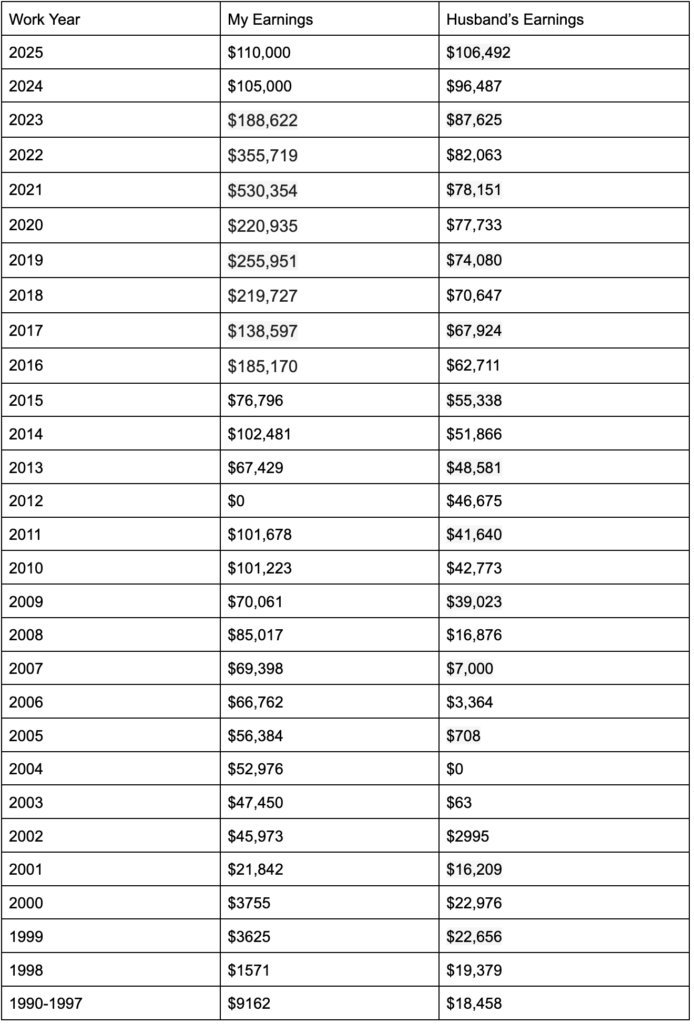
Her year-by-year earnings history, 1990 to 2025. The $530,354 spike in 2021 is the year the practice sale machinery started turning.
What they actually spend
Last year they spent just over $194,000 — their highest ever — because of an Iceland trip and 40+ overnights in the RV. Their norm is ~$140,000. The breakdown:
- $36,000 housing & maintenance (mostly mortgage + property taxes)
- $32,000 travel & lifestyle
- $24,100 food & dining
- $23,000 shopping
- $20,050 gifts & donations
- $15,500 education (3 college semesters + his final classes)
- $13,500 medical & wellness
- $10,000 gas & auto
- $8,800 utilities & phone
- $7,500 personal insurance
- $3,600 fees & legal (they did estate planning last year)
They also saved $75,000 to brokerage and $54,500 to retirement, and paid $69,000 in taxes (estimates + withholding at the time of the interview). Their savings rate was 34% last year, right around 50% in 2024.
The habits I’d steal
Three of her answers stood out to me:
1. She never buys anything full price. “I love seeing our balance grow and the gamification of it makes me giddy,” she said. Sound familiar? That’s the whole saving game in one sentence. She also says they swore off car loans in 2014 and never looked back — three used cars for three kids, plus the RV, all bought with cash.
2. They plan for windfalls before they arrive. In the early years, extra money “vanished into thin air” because they had no investing plan. After she finally read The Simple Path to Wealth in 2018, every dollar of extra income got a job. When the business sold, that plan is exactly why the money got invested fast instead of evaporating.
3. They buy quality, not quantity. Her husband is a Consumer Reports person who reads the Buy It For Life threads on Reddit. They also did their own home’s electrical, floors, tile, and paint — most of that home equity is literally sweat equity.
The honest risks
Not every part of this is a model plan. About $375,000 of her net worth is tied to a single company’s potential recapitalization — it could stay at $375,000 or multiply many times, and nobody knows when the event happens. The syndications haven’t gone a full cycle yet, and the commercial building’s rent escalations of 2.5% per year only start in April 2026. She’s openly considering selling the commercial property to cut all geographic ties.
Her own advice, which I think is underrated: if you’re a late starter, start anyway. In 2014, 15 years into the marriage, her traditional retirement savings totaled $45,000. By late 2023 that same account passed $500,000. Her Vanguard-reported return since September 2021 is 19.30%, with a 3-year return of 23.60% — past performance, not a promise, but real numbers.
Worth It?
Worth it — as a template, not a checklist. Their edge was a business sale, which most of us won’t replicate. But the boring parts — 34–50% savings rates, index-fund core, no car loans, a plan for every windfall — are copyable today.
- Do they have a budget? Not a formal one. They run savings off the top, track everything in Monarch, and monitor the rest. In the lean years they used budget envelopes.
- When do they retire? She’s targeting age 51 (April 2028), he’s targeting 57 (June 2031) with an estimated $600,000 pension attached. She may stay on at the company that bought her practice if an opportunity is interesting.
- What’s their target net worth? $3,750,000 in brokerage and retirement accounts — anything beyond that is icing on the cake.
Not professional financial advice — just one couple’s actual numbers, shared for what they’re worth.
A note from Dana: What got me was the honesty — the gym side-project that nearly broke them, the zero college savings panic in 2018, the admission that spending crept up the year they celebrated. No one who built $4.8M did it without a few ugly detours. If you’re sitting on a modest balance and thinking it’s too late to start, the 2014-to-2023 line in this interview is your answer. Worth a read before your next big purchase, and if you’re tracking your own net worth, start with a free budgeting app — she used one to keep every number above honest. Related: our full breakdown of money-saving habits that actually compound.